.avif)

Blog Summary / Key Takeaways
• The right outsourced bookkeeping company for a CPA firm must offer a dedicated model, CPA firm experience, SOC 2 security certification, structured onboarding, and a pilot option before commitment.
• The top providers in 2026 are Etisson, QX Accounting, TOA Global, Entigrity, and Outbooks. Each serves a different firm size and priority profile.
• Etisson offers the fastest onboarding at 48 hours and the only structured 40-hour free pilot in the market as a standard offering.
• Monthly costs range from $1,200 (Etisson) to $3,500 (TOA Global) versus $6,250 to $8,917 per month for a fully loaded US bookkeeper.
• Small firms (3 to 15 staff) are best served by Etisson. Mid to large firms by QX Accounting or Entigrity. Enterprise firms by QX or TOA Global.
• Ask all eight evaluation questions before signing with any provider. How they answer tells you as much as what they answer.
• The 40-hour pilot at Etisson removes the financial risk from the first engagement entirely.
Outsourced Bookkeeping Companies for CPA Firms: A 2026 Comparison
You are past the research phase. You know outsourced bookkeeping is the right move for your firm. Now you need to know which company to actually trust with your client files, your standards, and your firm's reputation.
This post gives you a direct, honest comparison of the leading outsourced bookkeeping companies for US CPA firms in 2026. What each model includes, where they differ, what they cost, and the questions you must ask before you sign with anyone.
No vague descriptions. No marketing language. Just the information you need to make the decision.
What Should CPA Firms Look for in an Outsourced Bookkeeping Company?
CPA firm bookkeeping requirements are different from small business bookkeeping requirements. You need a company that understands your review process, your software stack, your quality standards, and how work flows inside a practice management system.
Five criteria separate the right fit from the wrong one.
Dedicated professional model.
Your bookkeeper should work exclusively for your firm. A shared model means one professional is handling multiple unrelated client firms simultaneously. Your clients are never the priority in that arrangement. For CPA-level standards where client familiarity and format consistency matter, dedicated is non-negotiable.
CPA firm-specific experience and training.
There is a meaningful difference between a provider that serves small businesses and one that serves CPA firms. CPA firm bookkeeping involves working under a review process, following month-end close checklists, understanding workpaper standards, operating inside practice management tools like Karbon, and maintaining consistency across a portfolio of clients rather than a single entity. Ask specifically whether the provider has trained their professionals on CPA firm workflows, not just general bookkeeping.
Security documentation.
SOC 2 Type II and ISO 27001 are the two standards. Ask for the actual certificate documents. The FTC Safeguards Rule requires you to document that any third party handling client financial data meets appropriate security standards. A claim on a website is not documentation.
Onboarding structure and speed.
Slow onboarding is expensive in partner time and delayed client work. A provider that takes six to eight weeks to get a professional productive costs you real money before a single invoice is generated. Ask for a specific onboarding timeline with a day-by-day breakdown. Vague promises of getting you up and running quickly translate to long real timelines.
Trial or pilot option.
You should not commit to a long-term engagement with any bookkeeping company without evaluating real work output on your actual client files first. This is not a high bar. Any provider confident in their work quality should offer it without hesitation.
Who Are the Top Outsourced Bookkeeping Companies for CPA Firms in 2026?
Here is an honest breakdown of the most referenced options in the market, based on what CPA firms report in the field.
Etisson.
India-based. Dedicated professional model. Serves 100+ US CPA firms. Covers bookkeeping, controller services, close and finalization, tax prep support, catch-up and cleanup, and migration work. 48-hour onboarding. 40-hour free pilot before any commitment. Specifically built for smaller to mid-size CPA firms that want dedicated professionals integrated into their workflow.
QX Accounting Services.
India-based. Serves 350+ US CPA firms. Strong training infrastructure with SOC 2 and ISO 27001 certifications. Covers the full accounting and audit stack. Best fit for mid to large firms with high volume and structured workflows. Onboarding takes one to two weeks. No standard pilot offering.
TOA Global.
Philippines-based. Serves 1,100+ firms across the US, Australia, and New Zealand. Has its own registered training organization, the Ab2 Institute of Accounting. Strong staff retention record. Higher cost than India-based alternatives. Best for firms wanting a long-term staffing relationship and willing to invest in a longer onboarding period.
Entigrity (MYCPE ONE).
India-based. Works exclusively with CPA and accounting firms. Dedicated FTE model with transparent pricing. Covers the full bookkeeping and accounting stack. Good option for CPA-only provider focus. No standard pilot offering.
Outbooks.
India and UK-based. Serves CPA firms and small businesses. Flexible engagement models including staff augmentation, per-hour, and managed service options. Good for firms that want pricing model flexibility above all else.
How Does Etisson Compare to Other Bookkeeping Providers?
| Factor | Etisson | QX Accounting | TOA Global | Entigrity |
|---|---|---|---|---|
| Location | India | India | Philippines | India |
| Firms served | 100+ | 350+ | 1,100+ | Not public |
| CPA firm focus | Yes | Yes | Yes | Yes (exclusive) |
| Dedicated model | Yes | Yes | Yes | Yes |
| Onboarding time | 48 hours | 1 to 2 weeks | 3 to 4 weeks | 1 to 2 weeks |
| Free pilot | Yes, 40 hours | No standard | No | No |
| SOC 2 | Yes | Yes | Yes | Yes |
| ISO 27001 | Yes | Yes | Not listed | Not listed |
| Best firm size | 3 to 25 staff | 10+ staff | All sizes | 5 to 30 staff |
| Cost vs US hire | ~40% | ~40 to 45% | ~45 to 55% | ~40 to 48% |
The most material differences for a firm making a first engagement decision are onboarding speed and pilot availability. Etisson's 48-hour onboarding and 40-hour free pilot are the most accessible entry point in the market for small to mid-size CPA firms. No other provider on this list offers a structured free pilot as a standard offering.
What Does Outsourced Bookkeeping Cost Across Different Providers?
Pricing varies by model and provider. Here is what to expect in 2026 across the market.
| Provider | Model | Monthly Cost | Annual Cost |
|---|---|---|---|
| Etisson | Dedicated FTE | $1,200 to $2,400 | $14,400 to $28,800 |
| QX Accounting | Dedicated FTE | $1,500 to $2,800 | $18,000 to $33,600 |
| TOA Global | Dedicated FTE | $2,000 to $3,500 | $24,000 to $42,000 |
| Entigrity | Dedicated FTE | $1,400 to $2,600 | $16,800 to $31,200 |
| US bookkeeper (fully loaded) | Salary + benefits | $6,250 to $8,917/mo | $75,000 to $107,000 |
All offshore options represent significant savings versus a US hire. The primary decision factor should not be which provider is cheapest. It should be which provider's model, onboarding structure, and staff retention record gives you the best chance of a successful long-term engagement that does not require restarting every 9 to 12 months.
Which Model Works Best for Your Firm Size?
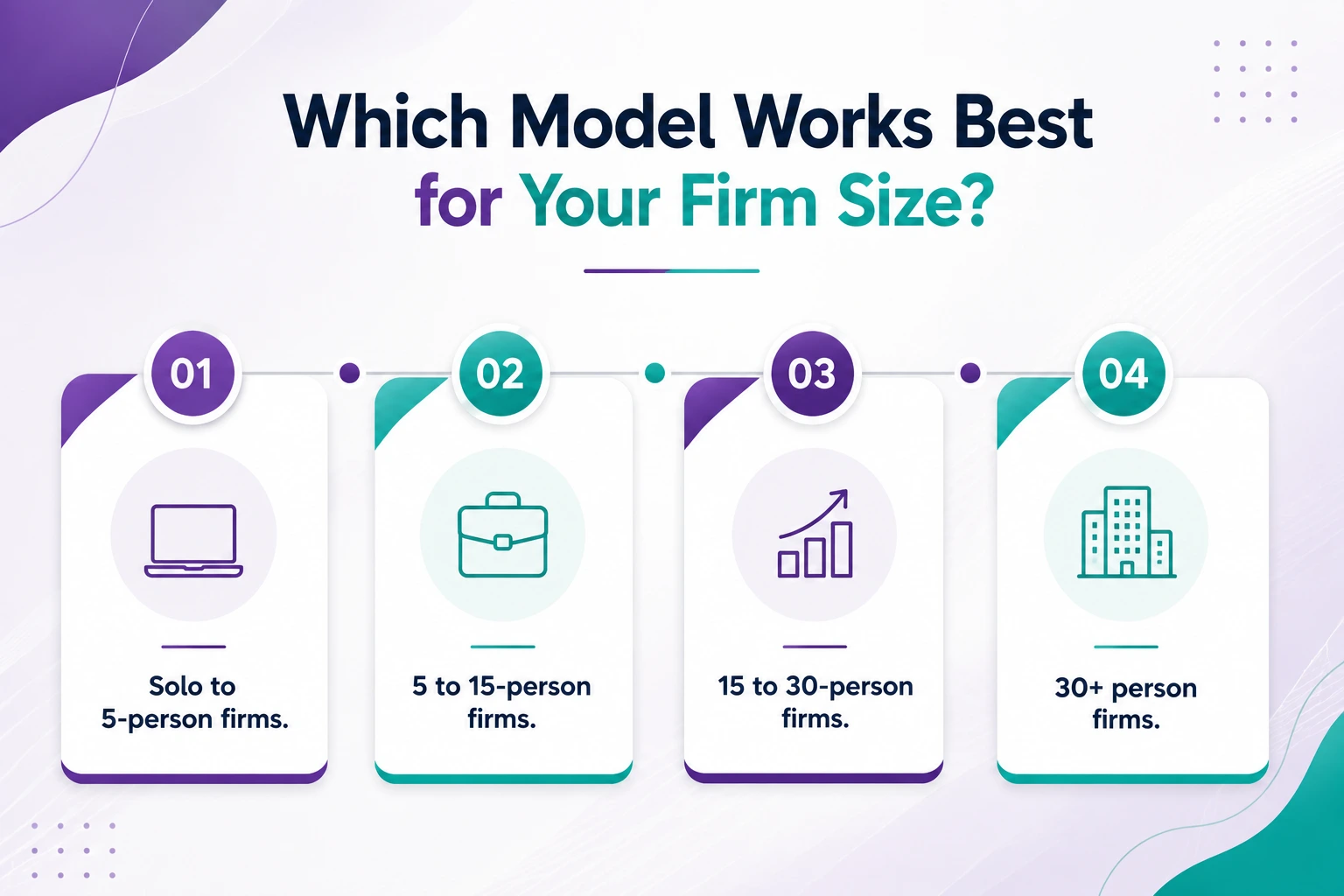
Solo to 5-person firms.
You need one bookkeeper who can handle 8 to 15 clients independently, start fast, and be evaluated before commitment. Fast onboarding and a pilot option are the most important criteria. You cannot afford three months of difficult onboarding. Etisson is the clearest fit.
5 to 15-person firms.
You likely need one to two bookkeepers and potentially a senior accountant for controller-level clients. You can absorb a slightly longer onboarding period. You benefit from a provider with service depth across the full accounting stack. Etisson and QX Accounting both serve this range well.
15 to 30-person firms.
Higher volume, more complex client mix, possibly audit support needs. QX Accounting and Entigrity are better fits. Their infrastructure and team depth handles the volume and service complexity more effectively.
30+ person firms.
Enterprise security requirements, audit support, and volume processing are the primary criteria. QX Accounting and TOA Global have the scale and compliance infrastructure for this level.
Outsourced Bookkeeping vs Virtual Bookkeeper vs Offshore Bookkeeping
Firms mix these terms, which makes provider comparisons confusing. Here is the clean operational distinction.
| Term | What it actually means |
|---|---|
| Virtual bookkeeper | Describes remote delivery, not necessarily offshore. The person may be US-based and simply working remotely. |
| Outsourced bookkeeping | Describes the sourcing model. A company provides a team, a process, and coverage, not just one remote individual. |
| Offshore bookkeeping | Means the work happens outside the US, usually to gain coverage hours and expand capacity at lower cost. |
A hybrid model, with offshore production and an onshore reviewer, is common and often the most practical setup for firms new to outsourcing. For a deeper look at how firms structure these engagements, see our guide to outsourced bookkeeping for CPAs and the four engagement models.
What Should a CPA Firm Keep In-House vs Outsource?
Not every bookkeeping-adjacent task is a good fit for an outsourced team. Knowing the boundary in advance prevents the most common complaint: a team that either does too little or oversteps into judgment calls it should not own.
| Outsources well | Keep in-house |
|---|---|
| Transaction coding and categorization | New accounting policy decisions |
| Bank and credit card reconciliations | Unusual or one-off transaction treatment |
| AP and AR tracking against subledgers | Client-facing calls involving sensitive topics |
| Month-end workpaper preparation | Final sign-off on financials |
| Missing-document follow-up with clients | Pricing and engagement-level decisions |
A useful rule of thumb: if the task requires judgment about what a number should be, keep it in-house. If it requires accurately recording and reconciling a number that is already known, it is a strong outsourcing candidate.
Cleanup vs Ongoing Monthly Bookkeeping
Cleanup and ongoing bookkeeping are different engagements and should be quoted separately. Cleanup has an unknown scope, so it is usually priced hourly or as a fixed fee for a defined period. Ongoing bookkeeping moves to a predictable monthly price once the close has stabilized.
A typical cleanup moves through three phases: triage and scoping, stabilizing the current month so the client stops falling further behind, and then historical reconciliation in a structured order. Firms that skip stabilization and fix old months first often find the client falls further behind during the project.
What Questions Should You Ask Before Signing?
Do not evaluate any provider based on their website or sales presentation alone. Ask these eight questions directly and pay attention to how they answer, not just what they say.
| Question | Why It Matters |
|---|---|
| What is your annual staff retention rate? | High turnover means repeated onboarding costs for your firm. |
| Can I see your SOC 2 and ISO 27001 certificates? | Security must be documented, not claimed. |
| What does onboarding look like day by day? | Vague answers mean longer real implementation timelines. |
| What happens when my assigned professional leaves? | Know the replacement process before it happens. |
| Do you offer a pilot or trial period? | Non-negotiable for any first engagement. |
| Which tools does your team train on? | Must match your existing software stack. |
| How do you handle quality issues and escalations? | Errors happen. Know the resolution path. |
| What does the contract say about rate escalation? | Know your Year 2 and Year 3 costs before signing. |
Any provider that deflects, gives marketing answers, or redirects to case studies instead of answering these questions directly is telling you something important about how they operate.
A Real Firm's Decision: Choosing Between Three Providers
A five-person CPA firm in New England was evaluating Etisson, QX Accounting, and Entigrity. They had one clear requirement: one dedicated bookkeeper, familiar with QBO and Karbon, available to start within two weeks, with a way to evaluate work quality before a long-term commitment.
They sent the same set of eight evaluation questions to all three providers.
QX Accounting confirmed QBO and Karbon familiarity but quoted a 10-business-day minimum onboarding with a 90-day commitment period before the first formal performance review. Solid credentials and clear process, but the commitment structure felt significant for a first engagement.
Entigrity confirmed familiarity with both tools but did not offer a standard pilot. The managing partner felt uncomfortable committing to a multi-month engagement without evaluating real work output first.
Etisson confirmed QBO and Karbon training on day one, offered the 40-hour free pilot as a standard offering, quoted 48-hour onboarding, and came in within the firm's budget. The managing partner ran the pilot. In 40 hours, the bookkeeper handled four client files across two reconciliation cycles and one full month-end close. Two minor adjustments were needed. Both were corrected the same day with a clear explanation of the reasoning.
They converted to a full engagement. Seven months later: the bookkeeper handles 18 monthly bookkeeping clients independently. The managing partner has recovered nine hours per week that she was previously spending in production. Three of those hours now go toward a CFO advisory service she had been wanting to launch for two years. The other six go toward business development conversations with prospective clients.
The managing partner's assessment: the 40-hour pilot told us everything we needed to know before we spent a dollar.
Why Etisson Works for Firms That Want Dedicated Professionals
Etisson is not the right choice for every firm. If you need audit support at scale, high-volume tax return processing, or enterprise security infrastructure with multiple certifications beyond SOC 2 and ISO 27001, other providers on this list are better fits.
Etisson is built for CPA firms that want one or two dedicated professionals who learn your clients, integrate into your workflow, and operate under your review process long-term. The 40-hour free pilot exists because we are confident in the quality of that match. The 48-hour onboarding exists because we know that slow starts cost you in partner time before you see a single return on the engagement.
100+ US CPA firms have built this model with Etisson. The consistent outcome is the same: production handled by dedicated professionals, internal staff freed for higher-value work, and the firm adding clients without adding US headcount.
FAQs
What is the best outsourced bookkeeping company for CPA firms?
It depends on firm size. For small to mid-size CPA firms (3 to 25 staff), Etisson offers the fastest onboarding and the only structured free pilot. For larger firms, QX Accounting and TOA Global have more infrastructure depth.
How much does outsourced bookkeeping cost for CPA firms?
Dedicated offshore bookkeepers cost $1,200 to $3,500 per month depending on provider and role level. US bookkeepers cost $6,250 to $8,917 per month fully loaded. The offshore savings are 40 to 75%.
What makes a good outsourced bookkeeping company for CPA firms?
Dedicated model, CPA firm-specific training, SOC 2 certification, fast structured onboarding, strong staff retention rate, and a pilot or trial option before commitment.
Can small CPA firms use outsourced bookkeeping companies?
Yes. Etisson works with firms from solo CPAs to 25-person practices. The dedicated model scales down to a single professional for a small firm at a price point that makes economic sense.
What is the difference between Etisson and QX Accounting?
Etisson has faster onboarding (48 hours vs 1 to 2 weeks), a structured 40-hour free pilot, and is built for smaller to mid-size CPA firms. QX has more scale and audit support infrastructure, better suited for mid to large firms with higher volume.
How do I verify that an outsourced bookkeeping company is secure?
Ask for their SOC 2 Type II certificate and ISO 27001 certificate as documents. Do not accept website claims or marketing PDFs. Request the actual compliance documentation.
What happens if my outsourced bookkeeper leaves the provider?
Ask this question before signing. Etisson has a defined replacement and transition process. The 40-hour pilot lets you evaluate a new professional before committing to the ongoing engagement. Every client file should have documented work history accessible to the replacement from day one.
Conclusion
Choosing the right outsourced bookkeeping partner isn't about finding the lowest price...it's about finding a team that fits the way your CPA firm operates. A provider with dedicated professionals, strong security standards, smooth onboarding, and proven experience can help you reduce operational pressure while creating more time for advisory services and client growth. Compare your options carefully, ask the right questions, and whenever possible, evaluate real work before making a long-term commitment. The right partnership should feel like an extension of your firm, not just another vendor.
Ready to evaluate a dedicated bookkeeper on your actual client files?
Start your 40-hour free pilot: https://meetings.hubspot.com/nick2204
.avif)